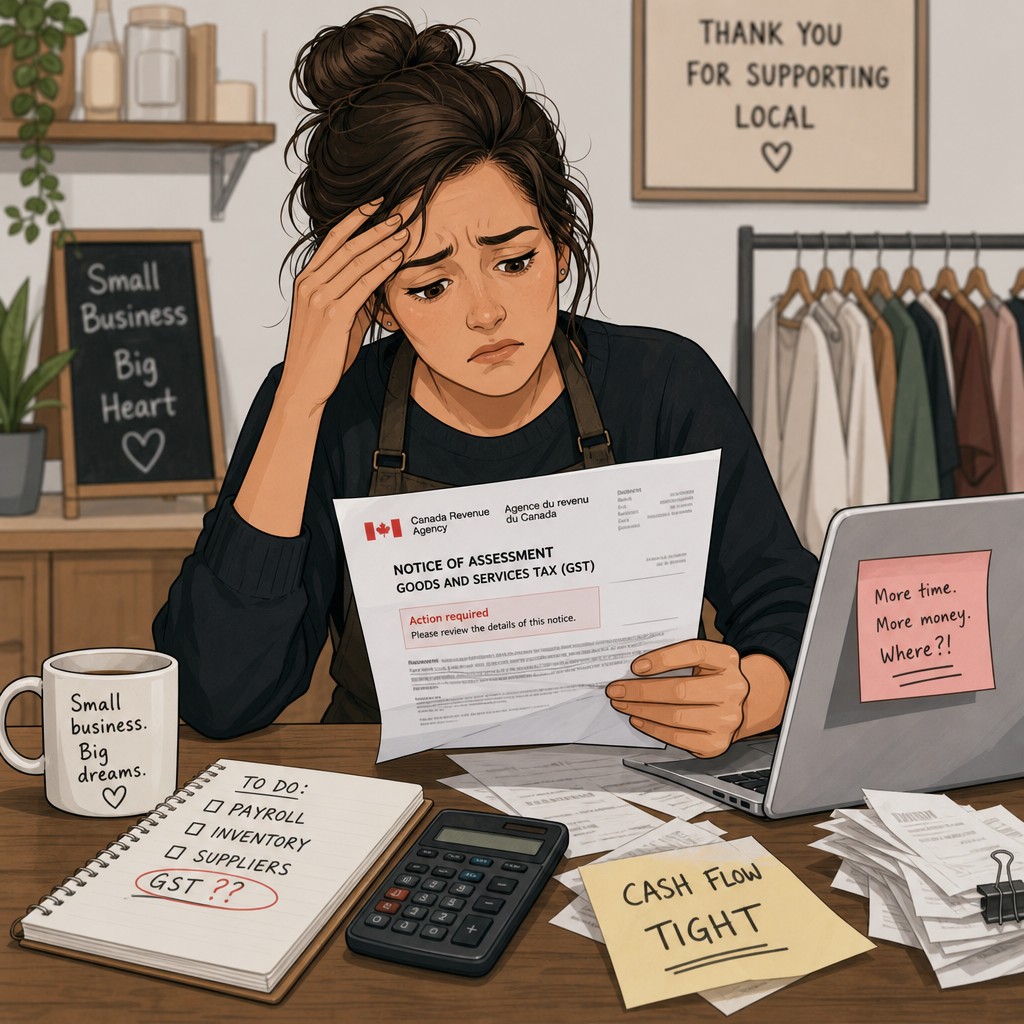

A Quick Reality Check
Before the rules and the worked examples, if two or more of these describe where you are, this guide was written for you.
- You started a business this year and you have no idea whether you are supposed to charge GST.
- You crossed $30,000 in revenue at some point and you keep meaning to figure out what comes next.
- You're a B2B consultant or contractor and your clients keep asking for your GST number.
- You sell physical products in BC and you suspect you should be charging PST too — but nobody has explained how.
- You charged GST without registering because someone told you to. (You should not have.)
- You are about to invest in equipment, a laptop, or software and you wonder if registering early would save you money.
- You have been a sole proprietor for years and you got a CRA letter asking why you have not been collecting GST.
If any of those land, you are exactly the size and stage of business this guide is for. The rest of it is the plain-language version of the conversation we have with new small businesses every week.
When do I have to register for GST/HST in Canada?
You must register the moment your worldwide taxable revenue (yours plus any associated businesses) crosses $30,000 in any single calendar quarter, or in the previous four consecutive calendar quarters. There are two ways to cross the line, and they trigger different deadlines:
- You exceed $30,000 in a single calendar quarter. You stop being a small supplier the moment the threshold-crossing supply happens. You must charge GST/HST on that supply and register within 29 days.
- You exceed $30,000 over four rolling quarters. You get one extra month as a small supplier, then registration becomes mandatory within 29 days of the end of that extra month.
Critically, this is a rolling calculation, not a fiscal-year one. Owners we onboard regularly assume that because their last T1 showed $26,000 they are safe, when in fact a strong fall and winter have already pushed their trailing four quarters over $30,000. Check your trailing four quarters every time you close the books, not just at year-end.
What is the small supplier threshold in Canada?
The small supplier threshold is the dollar level below which you do not have to register for GST/HST. In Canada it is $30,000 in worldwide taxable revenue (taxable supplies, including zero-rated). It applies to your business plus any associated businesses combined. Below that threshold you are a "small supplier" and registration is voluntary; above it, registration is mandatory.
Why some small business owners register voluntarily before $30,000
Registering before you hit the threshold feels counterintuitive — why invite paperwork? But voluntary registration is the right move when:
- Your customers are other GST-registered businesses. They reclaim the tax you charge, so the GST is invisible to them — and you get to claim input tax credits (ITCs) on your own purchases.
- You have meaningful start-up costs. Equipment, software, professional fees — registering lets you recover the GST/HST on all of it.
- You sell to clients outside Canada. Exports are zero-rated, meaning you charge 0% GST/HST but still claim ITCs on your inputs.
For a B2B consultant in Vancouver buying a $4,000 laptop and software stack, voluntary registration recovers a few hundred dollars and signals professionalism to clients who expect a GST number on every invoice.
When voluntary registration is a bad idea
If your customers are individual consumers — think a yoga instructor charging $90 a session, or a small online retailer selling to the public — adding 5% GST makes you 5% more expensive than the unregistered competition. Until you cross the threshold, you are usually better off staying small supplier and keeping your prices clean.
How to register for GST/HST in Canada
Three ways to register, all free:
- Online through the CRA's Business Registration Online portal at canada.ca. Fastest. You walk out with a GST number the same day.
- By phone at 1-800-959-5525 (CRA Business Enquiries).
- By filing Form RC1 (Request for a Business Number and Certain Program Accounts) by mail or fax.
You will be asked for:
- Your business number (or you will get one during registration)
- Your effective registration date
- Estimated annual taxable supplies
- Your reporting period preference (annual, quarterly, or monthly)
For most small businesses under $1.5 million in revenue, annual reporting is fine. It means one GST return per year and quarterly instalments above a certain net tax threshold. Choose monthly only if you genuinely have material refundable balances every month, otherwise you are creating 12 deadlines for no benefit.
GST plus PST: the BC-specific overlap that catches owners out
GST/HST is federal. BC's Provincial Sales Tax is separate and operates under its own rules. You generally must register for PST if you sell or lease taxable goods, sell software, or provide certain taxable services (legal, telecommunications, accommodation) in BC.
The PST small seller threshold is much lower than the federal one — $10,000 in gross revenue from taxable BC sales. The exemption only applies to occasional sellers; if your business holds itself out as a regular seller (online store, recurring market vendor), the exemption does not protect you.
PST returns are filed through eTaxBC, not the CRA. New BC owners conflate the two taxes every month: they register for GST, assume they are covered, and three years later receive a PST assessment with interest. If you sell taxable goods or services in BC, register for both.
What changes the day you become registered
- You must charge the correct rate on every taxable supply — 5% GST across Canada(except Ontario - 13% HST), plus 7% PST on taxable goods and certain services in BC.
- You must keep clean records of GST collected and GST paid on inputs (separate sub-accounts in your bookkeeping software).
- You file returns on your reporting schedule, even if revenue was zero (a "nil return" must still be filed by the deadline).
- You can claim ITCs for the GST you paid on legitimate business expenses.
- You become responsible for accurate sales tax reporting — the CRA can audit GST/HST returns up to four years back.
The bookkeeping reality
Good bookkeeping turns GST/HST from a stress event into a five-minute process. Every time you record an expense, the GST portion is split into a separate ledger account. At quarter-end your software tells you exactly what to remit. We use Zoho Books and QuickBooks Online with our clients and configure the tax codes once at the start so this happens automatically.
If your books are not set up this way, GST filing is a multi-hour reconciliation exercise every quarter. That is the #1 reason BC owners fall behind on filings.
Common mistakes that cost real money
- Forgetting that the threshold is rolling, not annual. We see this monthly.
- Registering for GST but not PST in BC. PST assessments arrive 1–3 years later with interest stacked on top.
- Charging GST without being registered. Illegal under the Excise Tax Act — and the CRA will ask for every dollar back, with penalties.
- Not claiming ITCs on legitimate business expenses. Recovering GST on a $4,000 laptop saves $200 — multiply across all your inputs.
- Choosing monthly reporting unnecessarily and creating 12 deadlines a year when one would do.
- Backdating registration without thinking about the consequences. The effective date controls how far back you can claim ITCs and when your first return is due.
Frequently asked questions
What is the GST registration threshold in Canada?
$30,000 in worldwide taxable revenue (yours plus associated businesses) in any single calendar quarter or in the previous four rolling quarters. Below this, GST/HST registration is voluntary. Above it, registration is mandatory within 29 days.
Do I have to register for GST if I make under $30,000?
No — you are a "small supplier" and registration is voluntary below $30,000. You may still want to register voluntarily if you sell B2B, have significant input costs you want to recover ITCs on, or sell to clients outside Canada.
How long does GST registration take in Canada?
Online through Business Registration Online: same day, often within 30 minutes. By phone: same day, ~15-minute call. By Form RC1: 4–6 weeks. Use the online portal unless you have a specific reason not to.
What is the difference between GST and PST in BC?
GST (5%) is federal, administered by the CRA, applies across Canada, and lets you claim input tax credits. PST (7%) is provincial in BC, administered by the BC Ministry of Finance, and does not allow input tax credits — it is a real cost when you buy taxable items. They are filed separately on different schedules. If you sell taxable goods in BC, you charge both.
Can I claim GST back as a small supplier?
No. Only registered businesses can claim input tax credits. As a small supplier you absorb the GST you pay on business inputs as a cost. This is a major reason many BC consultants register voluntarily before they have to.
What happens if I am late registering for GST?
CRA can backdate your registration to the date you should have registered, and demand the GST you should have charged on every taxable supply since then — even if you never collected it from customers. Penalties and interest stack on top. The fix is to register voluntarily before the CRA catches the omission.
Do I need to register for both GST and PST in BC?
Usually yes if you sell taxable physical goods or certain services in BC. The thresholds are different ($30,000 for GST, $10,000 for PST occasional sellers). They are filed separately. Conflating the two is one of the most expensive mistakes BC small businesses make.
Should I register for GST voluntarily?
Register voluntarily if (a) most of your customers are GST-registered businesses, (b) you have significant taxable input costs you want to recover GST on, or (c) you sell zero-rated supplies (exports, basic groceries, prescription drugs) — you collect 0% but still claim ITCs. Avoid voluntary registration if your customers are individual consumers, because the 5% GST makes you more expensive than unregistered competitors.
When to talk to us before you register
If two or more of these describe your situation, the registration date and reporting period decisions need a real conversation, not a guess:
- You crossed (or might have crossed) $30,000 over the last four quarters and you are not sure when.
- You bought equipment or software in the last 12 months and you want to recover the GST.
- You sell both to consumers and businesses, and you cannot tell whether registering helps or hurts.
- You sell physical goods or services in BC and you suspect you should also be PST-registered.
- You charged GST without being registered, and you are not sure how to fix it.
Getting the registration date right controls how far back you can claim ITCs and when your first return is due. We walk BC small businesses through this decision every week. Honest answers, no upselling. No judgement if you're behind.
Book a 30-minute call at fluentbook.ca and we will run the numbers together.
BC PST is expanding in October 2026 — separate from GST/HST
GST and HST registration is federal, but if you sell services in British Columbia there is a second registration to watch. Under BC Budget 2026 (Notice 2026-001), the 7% provincial sales tax extends to accounting and bookkeeping services and several other professional services effective October 1, 2026. If your business sells newly taxable services, you must register to collect PST with the BC government through eTaxBC — registration has been open since April 1, 2026 — and that is entirely separate from the GST/HST account this guide covers. Resale of goods and long-term residential rent are unaffected; check the notice for the full list of newly taxable services.